



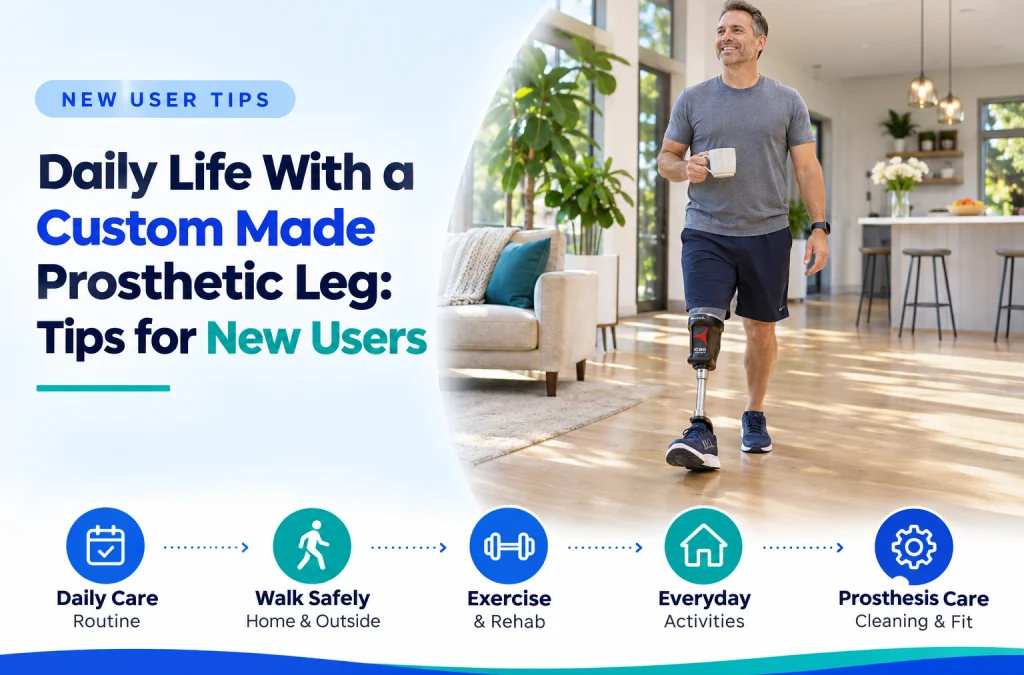
Getting used to personalized artificial limbs is not just about learning to walk, it’s a lot more than that. You also need to know how to put it on comfortably, look after your skin, manage changes in fit, and handle everyday tasks like getting dressed or moving around your home.
Some things take practice. Others, like a persistent pain or a sore spot on your residual limb, need immediate medical attention. If you know the difference, it will help you decide when to adjust your routine and when to contact your prosthetist.
We can’t give you one timeline for getting used to a prosthesis. Your experience will depend entirely on your health, the level of your amputation, how your residual limb is healing, the prosthesis fit, and the activities you want to do. Your prosthetist and rehabilitation team will help you work through the practical questions that you might have in the meantime.
In this blog, we will tell you some of the tips that can help you lead a normal, independent life, just like our Bernice, even with your custom made prosthetic leg on.
Key Takeaways
- Pay attention to fit and skin changes. Pain, persistent redness, blisters, and sores shouldn’t be ignored.
- Follow your own care instructions. Wearing schedules, cleaning methods and adjustments depend on your prosthesis and individual needs.
- Practise everyday activities safely. Walking on uneven ground, managing stairs and getting dressed can require different techniques.
- Ask for help when something changes. Your prosthetist can assess fit problems, and your healthcare team can advise you about skin concerns and other health issues.
Creating a Daily Care Routine
A proper, planned routine will help you take care of your skin, care for your prosthesis, and notice changes before they become harder to manage. I will tell you about a few steps you can follow:
Before putting on your prosthesis
- Look at your residual limb and see if there are any changes in color, swelling, blisters, sores, or areas of irritation.
- If you are not able to sense certain areas, visual checks are important because you might not feel a problem developing otherwise.
- Clean and dry your skin before putting on your prosthesis.
- Clean the socket, liner, and socks based on the instructions for your specific components.
- Moisture and friction are a big reason for causing skin irritation, so follow the care routine recommended for your equipment.
- If your prosthetist has given you a wearing schedule, please stick to it. Don’t increase your wearing time to speed up the adjustment process.
While wearing your prosthesis
- Pay attention to how the socket feels when you try to move.
- The volume of your residual limb can change during the day, and it can affect the fit.
- Your prosthetist will train you to use prosthetic socks to manage certain fit changes. Follow that guidance and don’t guess the number of layers to add or remove. You can check our YouTube video for socks related information.
- If you feel pain, pressure, or a new area of irritation, stop right there and see what is happening.
- Don’t keep walking through pain expecting the problem to get better automatically.
- If the discomfort continues or the fit changes significantly, contact your prosthetist.
At the end of the day
- Check your skin again, particularly the area where the prosthesis puts pressure on your residual limb.
- Clean the prosthetic components as instructed by your prosthetist and allow them to dry properly before using them again.
- If a sore spot or fit problem keeps returning, make a note of where it happens and when you first notice it.
- These details will help your prosthetist understand the problem during your appointment.
Common Challenges and What to Do
Some difficulties come from learning new movements or routines; those are not problematic. Others signal that your prosthesis or skin needs to be checked; don’t ignore them.
| What you notice | What to do |
| The socket feels loose or tight | Follow the fit-management instructions your prosthetist gave you. If the problem continues or the fit changes significantly, communicate that to your prosthetist. |
| Redness, rubbing or pressure | Check the area and avoid ignoring a mark that persists, worsens or returns. Contact your prosthetist or healthcare provider for advice. |
| Pain while wearing the prosthesis | Don’t treat ongoing pain as something you have to tolerate. Explain where it hurts and when it happens to your prosthetist or healthcare provider. |
| A blister, open sore or broken skin | Contact your healthcare provider and prosthetist. Ask for advice about whether you should continue wearing the prosthesis. |
| Feeling unsteady while walking | Use the walking aid recommended by your care team and ask your physical therapist to review your walking technique. |
| Feeling frustrated or discouraged | Talk with someone you trust or ask your care team about support. Adjusting to limb loss can involve emotional as well as physical changes. |
If your skin breaks down, an existing problem just becomes worse, or you notice signs of infection, contact your healthcare provider without any further delay. Seek urgent medical care for severe or rapidly worsening symptoms.
Don’t try to solve every problem by changing the prosthesis yourself. Just know that:
- Your prosthetist can assess the fit.
- Your healthcare provider can advise you about skin and other medical concerns.
Walking Safely at Home and Outside
When you’re just learning to use a prosthesis, even the familiar places will expose you to unexpected challenges. A loose rug, a wet restroom floor, or an uneven street will require more attention than it did before.
At home
- You can start with the spaces you use most often when you are at home.
- Remove clutter and loose rugs from the sidewalk.
- Make sure there’s enough room to move with any walking aid you’ve been advised to use.
- Good lighting is important to see changes in floor level and obstacles in your path.
Be careful when entering restrooms and entrances, as wet surfaces, steps, and narrow spaces can make movement more problematic.
Depending on your needs, these changes could make daily tasks easier:
- Non-slip surfaces
- A stable place to sit while dressing
Outside the home
- Choose routes that are not extremely uneven or difficult to walk.
- If you’re still working on balance or walking technique, ask your physical therapist to help you practise on surfaces or slopes you find difficult.
- Stairs, crowded areas and uneven paths will probably require different techniques.
- If you want to get back to an activity that seems difficult, discuss a safe way to work towards it instead of trying an unfamiliar technique on your own.
Exercise and Rehabilitation
Rehabilitation will make it easier for you to learn how to use your prosthesis during daily activities. The sessions will focus on your specific needs; some of them can include:
- Walking
- Balance
- Strength
- Coordination
- Endurance
Your physical therapist can help you practise movements such as:
- Standing up from a chair
- Turning
- Managing steps
- Getting in and out of a car
They can also help you work on tasks that are important to you, and by tasks we mean returning to work, managing household activities or taking part in your favorite hobby or sports.
Your programme is supposed to be all around your health, healing, current abilities and goals. It’s not necessary that one exercise that suits you will suit someone else.
- Don’t add demanding activities or increase your exercise without checking that the change fits your rehabilitation plan.
- If exercise causes pain, unusual swelling, skin irritation or a change in how your prosthesis fits, talk to your prosthetist as soon as possible.
Rehabilitation isn’t only about getting started to walk. Additionally, it involves learning to manage your energy, strengthening other parts of your body, and finding safer ways to complete everyday tasks.
Clothing and Everyday Activities
You will not have to replace your entire wardrobe after getting a prosthetic leg, and that’s not something we are suggesting either. The clothing that works best depends on:
- The shape and size of your prosthesis
- How easily you can dress
- What feels comfortable
Can you wear jeans with a prosthetic leg?
Yes, people can wear jeans with a prosthetic leg.
- Some people prefer stretch fabric or a wider leg opening because it makes dressing much easier.
- Others are comfortable in their usual styles.
- In case you find it difficult to wear jeans on your prosthesis, you can try a different cut or fabric.
- Don’t alter the prosthesis to accommodate clothing without advice from your prosthetist.
You also need to decide on the footwear. Changing shoes can affect the height or alignment of some prostheses.
- Follow your prosthetist’s advice about suitable footwear.
- Pay particular attention if you notice a difference in how you stand or walk after changing shoes.
Looking After Your Prosthesis
Your prosthesis needs regular care, and you must pay attention to your residual limb too. You must make sure that your prosthesis is properly suspended. Poor prosthetic suspension along with poor sock ply management often leads to major prosthetic fitting problems.
Cleaning and maintenance
- Follow the cleaning and maintenance instructions provided to you for your components.
- Don’t use a cleaning product or skin treatment unless it’s the best fit for your equipment and skin-care needs.
- Check for visible damage, loose parts, unusual noises, or changes in how the prosthesis feels.
- If you find that something has been damaged, contact your prosthetist.
- Don’t attempt repairs or adjustments you haven’t been trained to perform.
Changes in fit
The shape and size of your residual limb can change over time.
- Swelling
- Healing
- Weight changes
- Other health factors
These factors can affect how the socket fits. Regular follow-up appointments give your prosthetist an opportunity to assess the fit and discuss any problems.
Skin checks
Consider skin checks to be a very important part of your routine, even if you are using your prosthesis for a long time now.
Follow the care instructions that are specific to your circumstances, especially if you have reduced sensation or an existing skin problem.
Finding the right prosthetic care
If you’re searching for an ‘amputated leg prosthesis’, you’re likely looking for information about a prosthetic leg after an amputation. The type of prosthesis and the fitting process will depend on your individual needs, so a general description won’t be that useful to you.
The Bottom Line
Living with a prosthetic leg involves learning how your device fits, what your skin needs, and which techniques help you manage daily activities safely. Pay attention to changes rather than trying to push through pain or discomfort.
If you have a question about your prosthetic fit or care, contact ACCESS Prosthetics to discuss your concerns and the appropriate next step.
Frequently Asked Questions
How long does it take to get used to wearing a prosthetic leg?
There’s no fixed timeline. Healing, general health, the fit of the prosthesis, rehabilitation, and your goals all affect the adjustment period.
Your care team can explain what to expect at your current stage and review your progress as you practise daily activities.
How can you make a prosthetic leg more comfortable?
Start by following the instructions for putting on, wearing and caring for your prosthesis.
- Keep your skin and components clean and dry.
- Use the fit-management techniques your prosthetist has taught you.
- Seek advice from your prosthetist or healthcare provider about persistent pain, redness, blisters, or sores.
- Don’t make unapproved changes to the device to solve a significant fit problem.
What are the challenges of living with a prosthesis?
Common challenges include:
- Learning new walking techniques.
- Managing socket fit.
- Caring for your skin.
- Adapting daily routines.
Some people also need support with the emotional changes that can follow limb loss. The difficulties differ from person to person, so raise specific concerns with your prosthetist, rehabilitation team, or healthcare provider.