



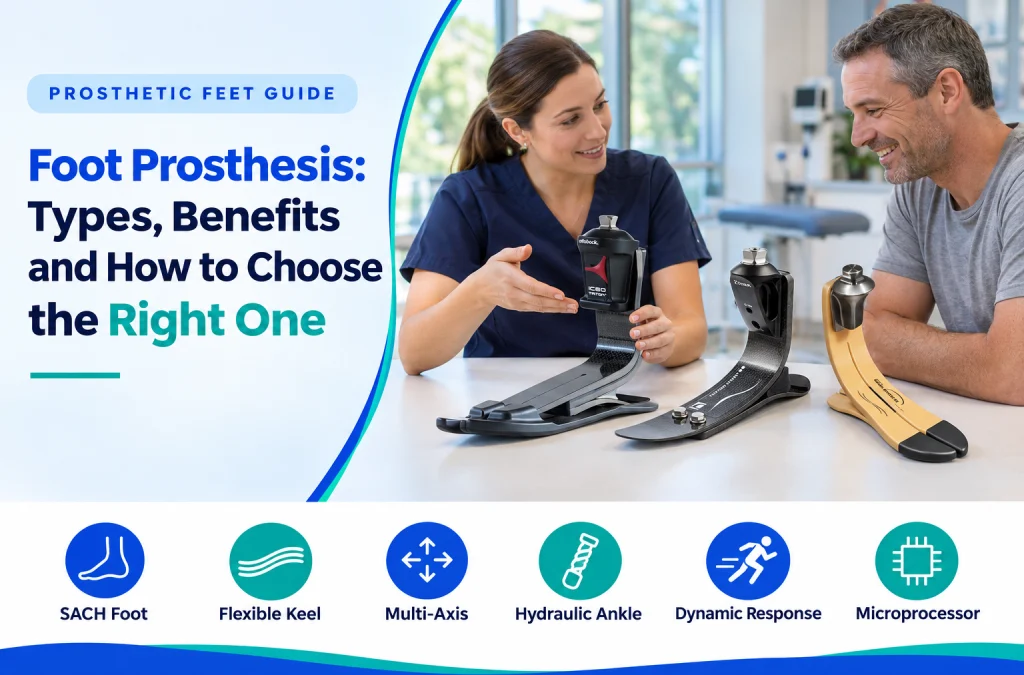
A prosthetic foot isn’t just an external add-on that helps you walk. It is supposed to feel steady on different surfaces, make walking comfortable, and fit into your daily routine. Data says the prosthetic foot market is expected to grow from USD 701.38 million in 2026 to USD 1,195.79 million by 2034, with an average annual growth rate of 6.9%.
If you are someone who wants to stay active or move around with more confidence, selecting the right type is very important.
The answer depends on more than the prosthetic foot itself. Your level of activity, the part of your foot or leg that has been amputated, your comfort, and the kind of movement you want to do all play a role here. While some prosthetic feet are designed to provide stability for everyday walking, others allow greater movement. If you’ve had a partial foot amputation, your needs will mostly be different from someone with a below-knee amputation.
In this article, we’ll explain the main types of prosthetic feet, including the SACH foot prosthesis, along with some factors to choose the right one. By understanding the options and benefits, you can have a more informed conversation with your prosthetist about what can work best for you.
Key Takeaways
- The right foot depends on your needs. We consider your amputation level, walking ability, physical needs, and daily activities before discussing suitable options.
- Each prosthetic foot works differently. Some provide steady support, while others offer more movement or help return energy as you walk.
- A partial foot prosthesis serves a different purpose. If you’ve lost only part of your foot, you may need a custom insert, brace, or partial foot replacement.
- Your goals matter. Tell us if you want to walk more comfortably, manage uneven ground, or return to sports. These details help guide the discussion.
What Is a Foot Prosthesis?
A foot prosthesis is an artificial foot that replaces your missing foot or part of one. It supports your body when you try to stand and walk, and forms part of a prosthetic limb. If you’ve had a below-knee amputation, your prosthetic foot connects to the rest of your lower-limb prosthesis. If you’ve lost only part of your foot, in that case you will need a different device to support the area that remains.
A prosthetic foot doesn’t move like your natural foot. Some designs are firm and provide basic support, while others are capable of bending, moving at the ankle, or returning some of the energy you use when walking.
Now, the type of prosthetic that suits your requirements matters, and you are right to question that. We start by looking at your physical needs and what you want to do on a daily basis. A foot that works well for someone who takes short walks will not be the right choice for someone who walks long distances or is fond of running and other similar activities. Stay tuned with us till the end, and you will find exactly what you’ve been looking for.
What Are the Different Types of Prosthetic Feet?
You will find prosthetic feet available in different designs. We’ll look at how each one works and what you should know about it.
1. SACH Foot Prosthesis
A solid ankle cushion heel (SACH) foot is a simple type among many. It has a firm inner section called a keel, with foam shaped around it that looks like a foot. This allows the ankle to stay rigid, while the cushioned heel compresses when your foot steps on the ground.
The design provides basic support and doesn’t move many parts. It is durable and generally needs little maintenance, thus making it suitable for people who walk at a steady pace and don’t need much ankle movement.
But we will tell you about the trade-off here as well. A SACH foot isn’t necessarily the right choice for uneven ground, so walking on slopes or rough surfaces can feel less natural.
You can also hear about a SACH foot being used early in the fitting process. In some cases, it is used as a temporary foot while a permanent prosthesis is being prepared. Whether that’s appropriate for you depends on your clinical needs and fitting plan.
2. Flexible Keel Prosthetic Foot
A flexible keel foot is similar to a SACH foot; the difference is that the inner section bends a little when you put weight on it. This small amount of movement helps the foot respond to the ground as you walk.
If you need a simple foot with some added flexibility, you can discuss this design with your prosthetist. It offers a balance of support and movement, although it doesn’t provide the same ankle motion as a foot with mechanical joints.
3. Single-Axis and Multi-Axis Prosthetic Feet
These prosthetic feet have mechanical ankle joints that allow movement.
A single-axis foot moves mainly up and down at the ankle. This helps the foot make flat contact with the ground sooner, which is definitely useful for someone who needs extra stability at the knee.
On the other hand, a multi-axis foot allows movement in more than one direction, including side to side. This can help when walking over uneven ground, turning, or even moving across slopes and curbs.
Both types provide proper support, and they have more moving parts than a basic foot, which makes them a little heavier as well. We look at your balance, knee stability, and the places you usually walk when discussing whether either design might suit you.
4. Hydraulic Ankle-Foot
A hydraulic ankle-foot uses fluid, such as oil, inside a mechanical system to control ankle movement. This allows the foot to move through the different stages of a step with a smoother rocking action. If you are walking on slopes or changing pace, hydraulic ankle-foot can be helpful. Hydraulic designs can also absorb some of the forces that pass through the prosthesis as you walk.
Whether these features will make a noticeable difference depends on the particular foot and, of course, your needs. Your prosthetist can explain how a hydraulic design compares with other options available to you.
5. Dynamic-Response Prosthetic Foot
Are you fond of walking longer distances or participating in activities?? A dynamic-response foot is a good option to discuss.
These feet use flexible materials, like carbon fiber, that bend under load and return some of the stored energy as you push off the ground. This spring-like action makes forward movement during walking much easier.
Dynamic-response feet are also called energy-storage-and-return (ESAR) feet. They can suit some more active users, but the amount of benefit varies from person to person. Your strength, walking pattern, prosthetic fit, and activity level all play an important part here. Many sports-specific prosthetic feet use dynamic-response designs. However, a foot made for everyday walking may not be suitable for every sport.
6. Microprocessor Prosthetic Foot
A microprocessor prosthetic foot uses sensors and computer controls to respond to your movements and the ground beneath you. Depending on the model, it adjusts how the foot behaves as you change speed or walk across different surfaces.
These feet use batteries, so they need regular charging. Some models also have limits on how much water, dirt, or moisture they can handle. They can cost more than basic designs and may weigh more, too. Also, we would like to let you know that not everyone is capable of getting a microprocessor prosthetic foot; it’s not that easily accessible for all.
A more advanced foot isn’t automatically the right one for every person. We would look at your walking needs, daily routine, and ability to manage the device’s care requirements before discussing whether this type of foot is suitable.
Comparing the Main Prosthetic Foot Types
If the different designs sound similar, this table can help you see how they are different. You can also use it to prepare questions for your next appointment.
| Foot type | Best suited for | Key advantage | Common limitation |
|---|---|---|---|
| SACH | People who walk at a steady pace and have lower activity needs | Simple, durable, and low maintenance | Limited flexibility on uneven ground |
| Single-axis | People who need extra knee stability | Helps the foot make flat contact with the ground sooner | Limited overall ankle movement |
| Multi-axis | People who walk on uneven ground and need movement in different directions | Handles slopes, curbs, and rotation well | Has more moving parts than basic feet |
| Dynamic-response (ESAR) | More active walkers and people who change pace | Stores and returns some energy during walking | Often costs more than basic feet |
| Microprocessor | People who may benefit from adaptive support | Adjusts to walking conditions and speed | Needs charging and may have limits on water exposure |
These descriptions are general. Your prosthetist will also consider how the foot works with the rest of your prosthesis and if it meets your individual needs.
What If You Want to Run With a Prosthesis?
If running is something you’d like to do, a prosthetic running foot is an option that can serve the purpose. It usually looks like a curved blade, bends when you land, and releases some of that stored energy as you push off. This design supports the repeated movements involved in running and differs from many feet designed mainly for everyday walking.
Before you start running, always talk with your prosthetist and physical therapist about your next plans. They will check and monitor your healing, strength, balance, and readiness for training. You will have to build up your activity gradually and learn how to move safely with the new foot.
A running foot won’t guarantee a particular speed or make running easy for everyone. Your experience depends on your physical condition, training, prosthetic fit, and the type of running you want to do.
What Is a Partial Foot Prosthesis?
If you’ve lost only part of your foot, you will probably not need a prosthesis that replaces the entire foot. A partial foot prosthesis is designed to support the missing area while working with the part of your foot that remains.
The right option depends on how much of your foot was removed, the condition of the remaining tissue, and how you walk. We can discuss options like:
- Custom shoe inserts: These fill the space left by the missing part of your foot and provide support inside your shoe.
- Ankle-foot orthosis (AFO): This brace supports the foot and ankle. Some designs can also help fill the missing area.
- Silicone partial foot prosthesis: This custom-made device replaces the missing part and can be shaped to look more like your natural foot.
- Carbon fiber footplate: This flexible plate extends toward the front of your shoe and can help with support and push-off as you walk.
A partial foot amputation can change the way you balance. The device needs to fit well with your remaining foot and your shoe. If there are signs of rubbing, pain, redness, or there’s some change in the way you walk, let your prosthetist know. Your skin problems are serious concerns; please don’t ignore them or keep using a device that causes continuous discomfort.
How Do We Help You Choose the Right Foot Prosthesis?
We want to understand what you need from your prosthesis before we discuss the available options with you. Below are some factors that we consider while recommending the right foot prosthesis:
Your amputation level
The level of your amputation matters a lot when deciding the components. After a below-knee amputation, your natural knee is still there, so we consider factors such as residual-limb length, strength, and range of motion. After an above-knee amputation, the prosthetic knee and how it works also affect the choice of foot.
Your walking ability and activity level
Tell us what your normal day looks like. Do you mostly walk around your home? Do you go outside often, cover longer distances, or walk on uneven streets? Perhaps you want to return to running or another sport. Tell us what you can do comfortably now and what you’d like to do in the future. This helps us discuss how much support, movement, or energy return you may need.
Your body weight and available space
Prosthetic feet are made for certain weight ranges and are available in different sizes. We need to make sure the foot is suitable for your body weight and fits within the available space. The length of your residual limb affects the space available for the foot after a below-knee amputation. After an above-knee amputation, the prosthetic knee also takes up space. These measurements help determine which feet can be fitted properly.
Your daily needs and personal goals
Your goals matter, even the smallest ones. You may want to stand longer while cooking your favorite dish, walk to a nearby shop, return to work, or feel more comfortable outdoors. Additionally, you can also observe how the foot looks inside your shoe. Let us know what matters to you. We will then discuss your options, explain the differences, and help you understand what to expect from the fitting process.
How Long Does It Take to Get Used to a Prosthetic Foot?
Getting a prosthesis usually involves a couple of appointments. We begin by discussing your needs and assessing your limb. Measurements are taken, and the device is designed in a way that fits you. The process can take weeks to months, depending on your healing, clinical needs, and the type of prosthesis.
Once you receive your foot, you’ll need time to learn how to use it and care for it. We can help with fit checks and adjustments, while a physical therapist can work with you on walking, balance, strength, and movement as appropriate.
There isn’t one timetable that works just fine for everyone. If something feels wrong, you can tell us rather than trying to push through pain. Small fitting concerns should always be discussed early.
The Bottom Line
Choosing a foot prosthesis starts with understanding what you need help with. You may need a simple, steady foot for everyday walking, a design that adapts better to uneven ground, or a specialty foot for running. If you’ve lost only part of your foot, a custom partial foot prosthesis may be a better option.
At ACCESS Prosthetics, we want you to feel comfortable asking questions and talking about your goals. If you’re considering a new prosthesis or have concerns about your current foot, speak with our clinical team about your prescription, fitting needs, and available options.
Frequently Asked Questions
- How do I know which foot prosthesis is right for me?
It depends on your amputation level, strength, walking ability, body weight, and daily activities. We recommend discussing these factors with your prosthetist so you can understand which options may suit you.
- Can I use a prosthetic running foot for everyday walking?
Some running feet are designed mainly for sports and may not be suitable for everyday walking. The right choice depends on the design and your needs. Your prosthetist can help you decide whether you need a separate foot for running.
- Does a partial foot prosthesis look like a natural foot?
Some partial foot prostheses, especially custom silicone designs, can be made to resemble the missing part of your foot. The final appearance depends on the shape of your remaining foot and the device selected.