


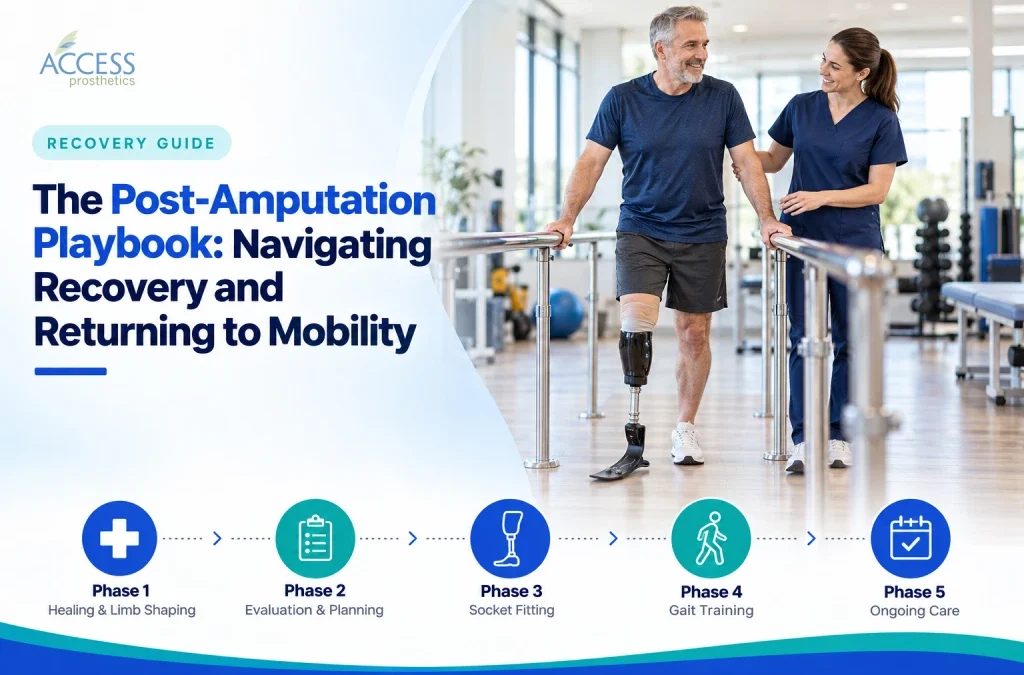
Undergoining amputation surgery and entering the recovery phase can feel overwhelming. Patients and their families are suddenly introduced to new medical terminology, physical rehabilitation schedules, and questions about what life will look like moving forward.
Having a clear roadmap helps remove the guesswork from your recovery. This post-amputation playbook outlines the essential stages of healing, from initial wound care to custom socket fabrication and returning to daily independence.
At Access Prosthetics, we guide patients through every phase of this transition, working alongside your surgical team, physician, and physical therapist to support your long-term mobility.
Phase 1: Surgical Healing and Limb Shaping
The immediate priority following surgery is allowing your incision to heal safely while preparing your residual limb for a future fitting.
During this early stage, your medical team focuses on managing swelling and shaping the limb. You will wear a specialized elastic compression garment, known as a shrinker sock, to reduce fluid buildup and mold the limb into a conical shape.
Key priorities during Phase 1 include:
- Wound Care and Inspection: Checking your incision daily for proper skin closure, keeping the site clean, and preventing infection.
- Desensitization: Lightly massaging and touching the limb over time to help lower nerve sensitivity as the area heals.
- Contracture Prevention: Performing gentle range-of-motion exercises to keep neighboring joints flexible. For a below knee prosthesis, keeping the knee completely straight while resting in bed is vital to prevent muscle tightness that could delay fitting.
Phase 2: Clinical Evaluation and Pre-Fitting Planning
Once your surgeon clears your incision and initial post-operative swelling stabilizes, your clinical prosthetic evaluation begins.
A reputable artificial limb company does not push pre-made or off-the-shelf products. Instead, your prosthetist reviews your doctor’s prescription, evaluates your muscle strength, examines your residual limb shape, and discusses your personal daily goals.
If you are wondering what does a prosthetic do at this stage of your care, its primary role is to restore physical balance, protect your sound side from overuse, and give you a functional tool to meet your personal movement goals—whether that means returning to work, managing your home, or staying active with family.
During this phase, your administrative team also verifies your insurance benefits, Medicare, or Veterans Affairs coverage, handling all prior authorizations before fabrication begins.
Phase 3: Diagnostic Socket Fitting and Alignment
Building a custom limb requires precise clinical crafting. The process centers on the socket, which is the custom-molded frame that attaches directly to your body.
Your prosthetist takes a precise cast or 3D scan of your limb to fabricate a clear plastic diagnostic socket. This test socket allows us to evaluate your fitting in real time:
- Pressure Spot Checks: Seeing through the clear plastic to verify where pressure lands and ensuring there are no hot spots or painful rub points.
- Alignment Tweaks: Adjusting the angle and position of the socket relative to the foot or wrist components while you stand or practice weight-bearing.
- Volume Management Education: Learning how to use prosthetic socks of varying ply thicknesses to maintain a snug, comfortable fit as your limb volume naturally fluctuates throughout the day.
For pediatric patients, careful socket fitting is especially important. Pediatric fittings require proactive monitoring so the socket can be adjusted or refitted smoothly as a child grows.
Phase 4: Delivery, Gait Training, and Rehabilitation
Once the diagnostic socket fits comfortably, your final device is assembled using light, durable materials like carbon fiber and high-strength composites.
Taking your device home is an exciting milestone, but structured physical therapy is where your real functional mobility takes shape. If you want to understand how does prosthetic limbs work during daily movement, your physical therapist and prosthetist work together to teach you:
- Weight Shifting: Learning to trust the prosthesis artificial limb to bear your weight during standing and walking.
- Gait Mechanics: Practicing an even, natural stride to protect your lower back and sound-side joints from overcompensation.
- Upper Limb Task Management: For users with upper limb prosthetics, practicing joint positioning, harness leverage, or muscle sensor control to handle daily household objects efficiently.
Phase 5: Long-Term Maintenance and Ongoing Adjustments
Recovery does not end when you receive your final device. Your body will continue to adapt, and your residual limb will naturally reshape over the first 12 to 18 months.
Maintaining long-term mobility requires routine check-ups every six months. Visiting your prosthetist regularly ensures that loose mechanical connections are tightened, wearable items like gel liners are replaced before skin breakdown occurs, and socket fit adjustments are made before minor pressure points become severe.
Frequently Asked Questions
How long after amputation surgery will I receive my first prosthesis?
Most patients receive their initial diagnostic fitting within 6 to 12 weeks after surgery. However, the exact timeline depends on how quickly your surgical incision heals, how well post-operative swelling is controlled, and when your doctor issues a formal prescription.
What should I do if my socket feels loose a few months after receiving it?
It is completely normal for your residual limb to shrink during your first year of wear as swelling goes down and muscles adapt. You can adjust for minor volume loss by adding prosthetic socks over your gel liner. If you are wearing multiple sock plies and the socket still feels loose or slips, contact your clinic to schedule a socket check or refit.
How often will my prosthetic socket need to be replaced?
Most active adults require a socket replacement every 2 to 4 years due to natural body changes, weight shifts, or normal material wear. Children and teenagers require more frequent refits to accommodate natural growth spurts.
Partner With Access Prosthetics
Navigating life after an amputation is a continuous process, and having an experienced clinical team by your side makes all the difference.
If you have questions about post-amputation care or want to review your prescription options, contact Access Prosthetics today to schedule an in-person consultation at our clinic.