


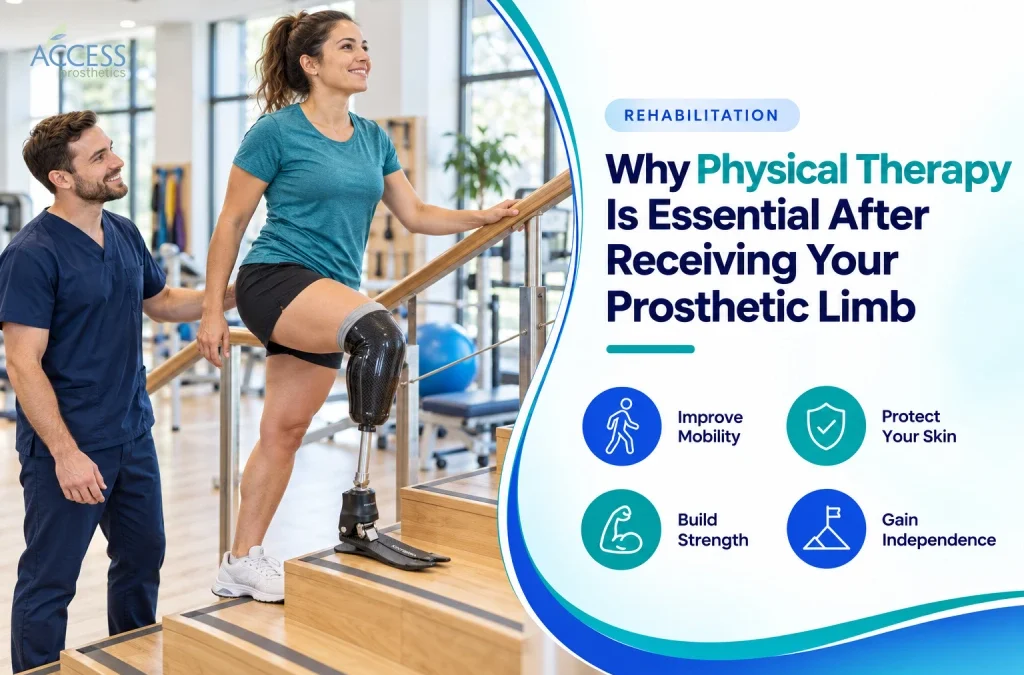
Taking your new prosthetic limb home from the clinic is a major milestone, but strapping on the device is only the first step in regaining your mobility. A prosthesis artificial limb is a sophisticated tool, and like any advanced medical tool, learning how to use it safely and efficiently requires structured practice.
This is where physical therapy becomes the bridge between receiving a custom prescription limb and actually moving with confidence.
At Access Prosthetics, we work side by side with local physical therapists to ensure your clinical fitting translates into real-world independence. Here is why dedicated physical therapy is a critical part of your recovery after you receive your device.
Retraining Your Brain and Body for Movement
Walking or reaching with a device is not automatic. Your body has to learn new movement patterns, redistribute weight, and adapt to how the socket interacts with your limb.
Without physical therapy, it is easy to develop subtle compensations. For patients with a below knee prosthesis, this often looks like hitching a hip, taking uneven steps, or relying heavily on your opposite leg. For those using upper limb prosthetics, it might mean twisting your torso to reach an object instead of using the mechanical joints of the device.
Over time, these faulty movement patterns put unnecessary strain on your lower back, sound side joints, and residual limb. A physical therapist watches your gait and posture in real time, catching bad habits early before they cause chronic pain or joint wear.
Protecting Your Skin and Managing Socket Comfort
A prosthetic socket changes how pressure and friction hit your skin. Even a perfectly fabricated socket requires your body to build tolerance over time.
Physical therapy sessions give you a controlled environment to build up that wear time under professional supervision. If you wonder how does prosthetic limbs work during active exercise, your physical therapist works directly with your prosthetist to monitor how your skin responds:
- Identifying Hot Spots: Spotting areas of excessive redness or pressure before they turn into painful sores or blisters.
- Volume Management: Teaching you how to use prosthetic sock plies throughout the day as your residual limb volume naturally changes with fluid shifts.
- Liner Care and Hygiene: Reinforcing daily skin care habits to keep your residual limb healthy and prevent skin breakdown.
If your therapist notices a spot where the socket continues to pinch or rub during exercises, they communicate directly with your prosthetist so we can make immediate alignment or socket tweaks in the clinic.
Building Core Strength and Dynamic Balance
Using a prosthetic device requires muscle groups that may have been inactive during your post-surgical recovery.
For amputees, strong core muscles, glutes, and hip stabilizers are essential for keeping your balance on uneven ground. A physical therapist designs targeted strength programs that focus on:
- Weight Shifting: Practice leaning into the prosthetic side so you trust the device to hold your body weight.
- Balance and Stability: Working on foam pads, ramps, and stairs to prepare you for real-world environments like gravel, grass, and curbs.
- Endurance: Gradually increasing your walking distance without causing fatigue that leads to trips or falls.
For pediatric patients, physical therapy is especially vital. As children grow, their strength, balance, and coordination change rapidly. Pediatric physical therapy ensures young patients build healthy movement habits while adapting to new socket sizes as they grow.
Learning Daily Functional Mobility
If you’re wondering what does a prosthetic do for your lifestyle, the ultimate goal is getting back to your normal routine, whether that means going back to work, playing with your kids, or maintaining your home independently.
Physical therapy goes beyond basic walking drills to focus on the exact tasks you perform every day:
- Navigating Obstacles: Stepping over curbs, walking up inclines, and handling steps safely.
- Sitting and Standing: Learning clean mechanics for getting in and out of chairs, cars, and low seats without overusing your sound side.
- Fall Prevention and Recovery: Practicing how to break a fall safely and, more importantly, how to get back up from the floor independently if a fall occurs.
A Collaborative Care Team for Your Long-Term Success
Your physical therapist and your prosthetist are two sides of the same care team. While an artificial limb company provides the initial fitting, your prosthetist ensures the device fits precisely, aligns correctly, and meets your doctor’s prescription orders, while your therapist teaches you how to maximize that device in daily life.
At Access Prosthetics, we maintain open lines of communication with your physical therapy team throughout your care. When your therapist gives feedback on how your limb moves during therapy sessions, we use that clinical data to fine-tune your socket alignment and component settings.
Frequently Asked Questions
When should I start physical therapy after receiving my prosthetic limb?
You should ideally begin physical therapy immediately after receiving your prosthesis. Your prosthetist and prescribing doctor will coordinate with your therapist to set a safe wear-time schedule and starting routine based on your incision healing and skin condition.
How long does physical therapy usually last after a prosthetic fitting?
The duration varies based on your personal mobility goals, activity level, and prior physical condition. Most patients attend structured therapy sessions two to three times a week for several weeks or months until they master safe gait mechanics, weight shifting, and daily functional tasks independently.
What should I bring to my physical therapy appointments?
Bring your complete prosthetic setup, including your gel liner, suspension sleeve, and a supply of prosthetic socks in different ply thicknesses to handle limb volume changes during exercise. Wear comfortable, loose-fitting clothing that allows your therapist to easily inspect your residual limb and socket fit.
Partner With Access Prosthetics
If you have questions about your prescription or want to learn how we partner with physical therapy providers, contact Access Prosthetics today to schedule an in-person consultation at our clinic.